

Exploring SIMD instructions in Rust
Hello 👋,
I started exploring Rust a week ago due to more and more web services being written in Rust at my work place and so far I like the language, it’s simple, fast and beautiful.
My day to day programming tasks are in Python, Go and Java. I’ve also used C# for some personal projects. Picking up Rust is not that easy for me since everything I write is web services or Java programs that don’t have “low-level” logic.
In this article I will talk about my journey with Rust and my experience of using std::simd. I find things that I don’t have much experience with fascinating. I also tried using SIMD with Go but that’s above my skill level, I could not get it to work.
What is SIMD?
The SIMD stands for Single Instruction/Multiple Data. Given a vector of 128 elements.
[1,2,3, …, 128]
When you’re adding the elements, you will loop through them. A typical code will lock like this:
int sum(int * arr, int size) { int sum = 0; for (int i = 0; i < size; i++) { sum = sum + *(arr + i); } return 0;}The generated assembly will look something like this:
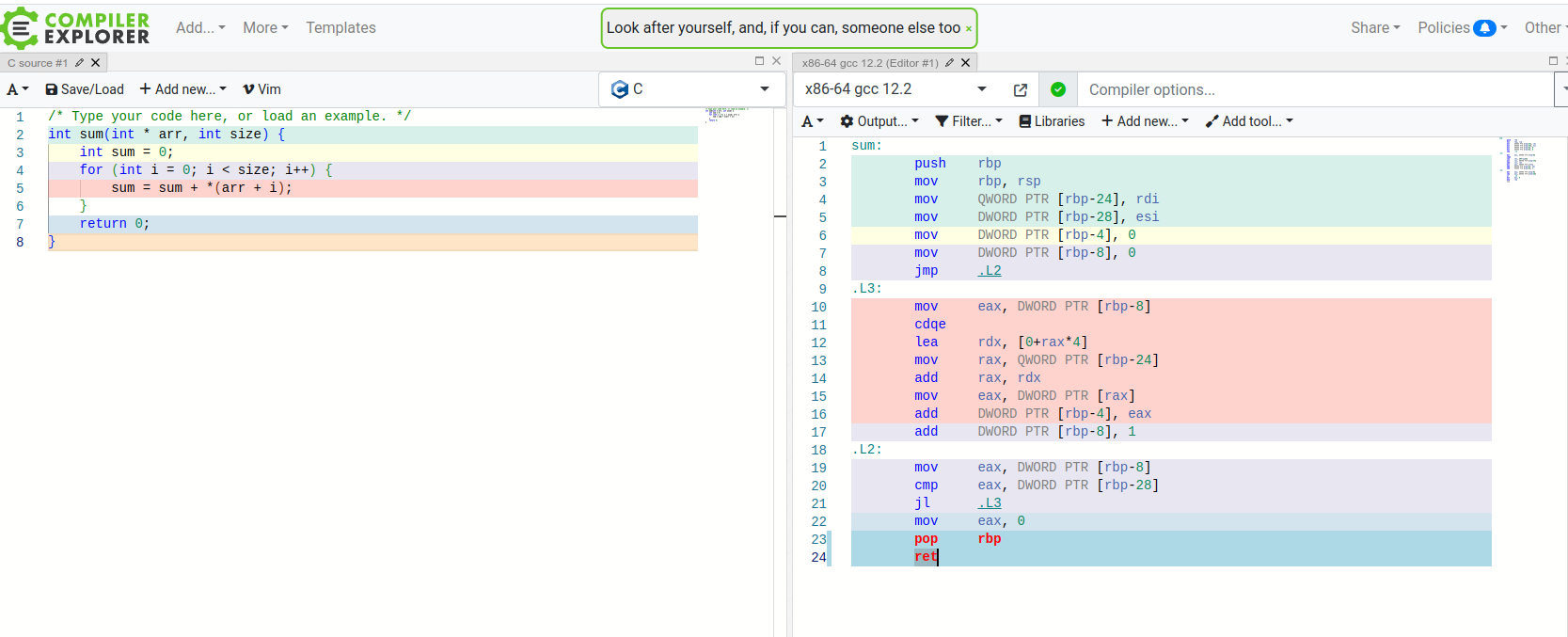 The code in RED is a the loop part, as you can see we have lots of instructions. Sometimes when the size is known, the compiler may choose to do loop unrolling, this means that instead of using JMP instructions and looping the compiler will do something like this, if the size is 3 for example:
int sum(int * arr, int size) { int sum = 0; sum = sum + *(arr + 0); sum = sum + *(arr + 1); sum = sum + *(arr + 2); return 0;}With SIMD instructions your CPU has support for assembly instructions that can work with vectors in an efficient manner. You may read more about SIMD and how it works in this excellent article Crunching Numbers with AVX and AVX2.
Basically given two vectors a and b you’re telling the compiler to do a mathematical operation on them and it will be efficient. Imagine that instead of looping though each element and executing the + operation; all elements are added at once:
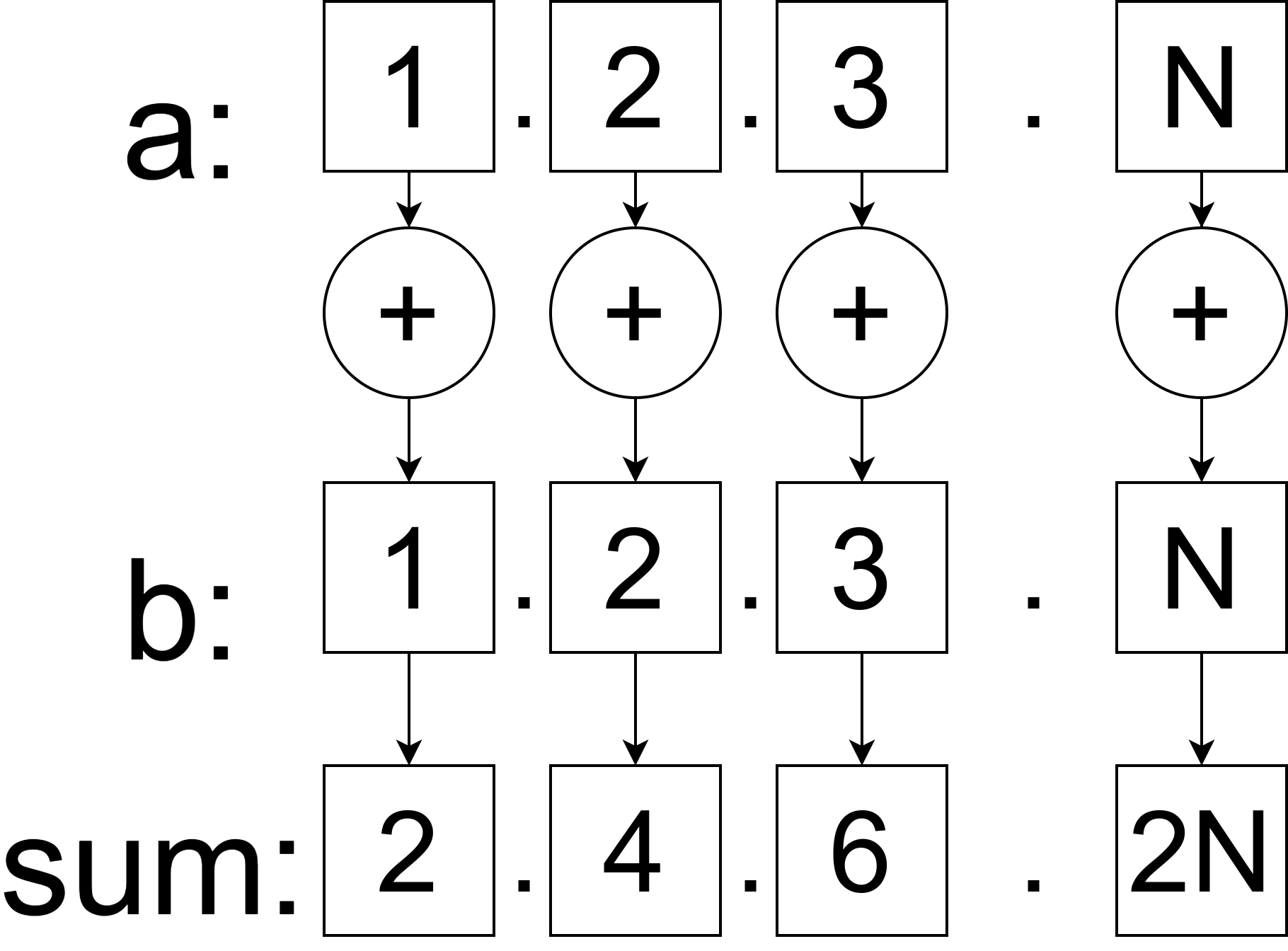 Now that we have a basic understanding of how SIMD works we can move to Rust.
Rust Program to compute hamming distance
Note:
if you want to follow along or run the code from this article you will need to install rust nightly version and set it as default:
rustup install nightlyrustup default nightlywhen you're done:rustup default stableThe problem we want to solve with SIMD instructions is to compute hamming distance on two vectors equal in size. The hamming distance between [1, 2, 3] and [1, 3, 3] is equal to 1 because 2 != 3, the rest of the elements are equal.
The non-SIMD Rust function looks like this:
#[inline(never)]fn hamming_distance_classic(a: &mut Vec<i32>, b: &mut Vec<i32>) -> u64 { let mut distance = 0; let length = a.len(); for i in 0..length { if a[i] != b[i] { distance += 1 } } return distance;}To preview the assembly a colleague recommended the cargo-show-asm crate. You can install it and run the following command to show the assembly code for the given function
cargo asm --bin rust_simd "rust_simd::hamming_distance_classic"The generated assembly looks like a simple loop:
.LBB12_4: cmp r8, rcx jae .LBB12_5 mov r10d, dword ptr [rdi + 4*r9] xor r11d, r11d cmp r10d, dword ptr [rdx + 4*r9] lea r10, [r9 + 1] setne r11b add rax, r11 mov r9, r10 cmp rsi, r10 jne .LBB12_4 pop rcx .cfi_def_cfa_offset 8 retNext, I’ll show my implementation that uses simd instructions:
#[inline(never)]fn hamming_distance_simd(a: &mut Vec, b: &mut Vec) -> u32 { let mut distance: u32 = 0; let lanes = 16; let chunks = a.len() / lanes; for i in 0..chunks { // create simd vectors let a: i32x16 = Simd::from_slice(&a[i*lanes..i*lanes+lanes]); let b: i32x16 = Simd::from_slice(&b[i*lanes..i*lanes+lanes]); // simd XOR let z = a.simd_ne(b); distance += z.to_bitmask().count_ones(); } return distance;}The assembly code for this function looks like this:
.LBB11_2: cmp r8, rsi ja .LBB11_6 cmp r8, rcx ja .LBB11_7 movdqu xmm1, xmmword ptr [rdi + 4*r8 - 64] movdqu xmm2, xmmword ptr [rdi + 4*r8 - 48] movdqu xmm3, xmmword ptr [rdi + 4*r8 - 32] movdqu xmm4, xmmword ptr [rdi + 4*r8 - 16] movdqu xmm5, xmmword ptr [rdx + 4*r8 - 64] pcmpeqd xmm5, xmm1 movdqu xmm1, xmmword ptr [rdx + 4*r8 - 48] pcmpeqd xmm1, xmm2 movdqu xmm2, xmmword ptr [rdx + 4*r8 - 32] pcmpeqd xmm2, xmm3 movdqu xmm3, xmmword ptr [rdx + 4*r8 - 16] pcmpeqd xmm3, xmm4 pxor xmm1, xmm0 pxor xmm5, xmm0 packssdw xmm5, xmm1 pxor xmm2, xmm0 pxor xmm3, xmm0 packssdw xmm2, xmm3 packsswb xmm5, xmm2 pmovmskb r10d, xmm5 mov r11d, r10d shr r11d and r11d, 21845 sub r10d, r11d mov r11d, r10d and r11d, 13107 shr r10d, 2 and r10d, 13107 add r10d, r11d mov r11d, r10d shr r11d, 4 add r11d, r10d and r11d, 3855 mov r10d, r11d shr r10d, 8 add r10d, r11d movzx r10d, r10b add eax, r10d add r8, 16 dec r9 jne .LBB11_2We can see that XMM registers are being used.
Benchmarking the code
To benchmark the code I’ve used a block of code that I’ve copied from a Rust SIMD page[1] and modified slightly.
mod bench { extern crate test; use self::test::Bencher; use std::iter; static BENCH_SIZE: usize = 128; macro_rules! bench { ($name:ident, $func:ident) => { #[bench] fn $name(b: &mut Bencher) { let mut x: Vec<_> = iter::repeat(1i32) .take(BENCH_SIZE) .collect(); let mut y: Vec<_> = iter::repeat(1i32) .take(BENCH_SIZE) .collect(); b.iter(|| { super::$func(&mut x, &mut y); }) } } } bench!(simd, hamming_distance_simd); bench!(vanilla, hamming_distance_classic);}The results are the following. The code written to use SIMD wins:
/home/denis/.cargo/bin/cargo bench --color=always --package rust_simd --bin rust_simd bench Finished bench [optimized] target(s) in 0.00s Running unittests src/main.rs (target/release/deps/rust_simd-2477d04109c1c861)running 2 teststest bench::simd ... bench: 14 ns/iter (+/- 0)test bench::vanilla ... bench: 20 ns/iter (+/- 0)Inlining the functions
If we remove #[inline(never)] then something interesting happens. The compiler sees that both functions are used only once and it decides to inline them.
If we run cargo asm –bin rust_simd the functions do not appear in the output:
Try one of those by name or a sequence number 0 "alloc::alloc::box_free" [15] 1 "alloc::raw_vec::RawVec::reserve_for_push" [136] 2 "alloc::raw_vec::finish_grow" [110] 3 "core::ops::function::FnOnce::call_once" [19] 4 "core::ptr::drop_in_place>" [31] 5 "core::ptr::drop_in_place" [27] 6 "core::ptr::drop_in_place::>" [7] 7 "main" [18] 8 "rand::rngs::adapter::reseeding::ReseedingCore::reseed_and_generate" [157] 9 "rust_simd::main" [787]10 "std::rt::lang_start" [28]11 "std::rt::lang_start::" [18]12 "std::sys_common::backtrace::__rust_begin_short_backtrace" [22]Benchmarking the code again yields the following result:
/home/denis/.cargo/bin/cargo bench --color=always --package rust_simd --bin rust_simd bench Finished bench [optimized] target(s) in 0.00s Running unittests src/main.rs (target/release/deps/rust_simd-2477d04109c1c861)running 2 teststest bench::simd ... bench: 20 ns/iter (+/- 0)test bench::vanilla ... bench: 0 ns/iter (+/- 0)The vanilla block (classic hamming distance) function is much faster, and if we look at the assembly code we can see that the Rust compiler is smart and it auto vectorized the code to use SIMD instructions, unlike me the compiler is smarter and it’s code is better:
.LBB11_56: movq xmm3, qword ptr [r15 + 4*rdx] movq xmm4, qword ptr [r15 + 4*rdx + 8] movq xmm5, qword ptr [rbp + 4*rdx] pcmpeqd xmm5, xmm3 movq xmm3, qword ptr [rbp + 4*rdx + 8] pcmpeqd xmm3, xmm4 pshufd xmm4, xmm5, 212 pandn xmm4, xmm2 paddq xmm4, xmm0 pshufd xmm3, xmm3, 212 pandn xmm3, xmm2 paddq xmm3, xmm1 movq xmm0, qword ptr [r15 + 4*rdx + 16] movq xmm1, qword ptr [r15 + 4*rdx + 24] movq xmm5, qword ptr [rbp + 4*rdx + 16] pcmpeqd xmm5, xmm0 movq xmm6, qword ptr [rbp + 4*rdx + 24] pcmpeqd xmm6, xmm1 pshufd xmm0, xmm5, 212 pandn xmm0, xmm2 paddq xmm0, xmm4 pshufd xmm1, xmm6, 212 pandn xmm1, xmm2 paddq xmm1, xmm3 add rdx, 8 add rsi, -2 jne .LBB11_56 test cl, 1 je .LBB11_59.LBB11_58: movq xmm2, qword ptr [r15 + 4*rdx] movq xmm3, qword ptr [r15 + 4*rdx + 8] movq xmm4, qword ptr [rbp + 4*rdx] pcmpeqd xmm4, xmm2 movq xmm2, qword ptr [rbp + 4*rdx + 8] pcmpeqd xmm2, xmm3 pshufd xmm3, xmm4, 212 movdqa xmm4, xmmword ptr [rip + .LCPI11_0] pandn xmm3, xmm4 paddq xmm0, xmm3 pshufd xmm2, xmm2, 212 pandn xmm2, xmm4 paddq xmm1, xmm2.LBB11_59: paddq xmm0, xmm1 pshufd xmm1, xmm0, 238 paddq xmm1, xmm0 movq rcx, xmm1 cmp rdi, rax je .LBB11_61The assembly for the hamming_distance_simd function looks like this:
.LBB11_40: cmp rdi, rax ja .LBB11_41 cmp rdi, r12 ja .LBB11_44 movdqu xmm1, xmmword ptr [r15 + 4*rdi - 64] movdqu xmm2, xmmword ptr [r15 + 4*rdi - 48] movdqu xmm3, xmmword ptr [r15 + 4*rdi - 32] movdqu xmm4, xmmword ptr [r15 + 4*rdi - 16] movdqu xmm5, xmmword ptr [r10 + 4*rdi - 64] pcmpeqd xmm5, xmm1 movdqu xmm1, xmmword ptr [r10 + 4*rdi - 48] pcmpeqd xmm1, xmm2 movdqu xmm2, xmmword ptr [r10 + 4*rdi - 32] pcmpeqd xmm2, xmm3 movdqu xmm3, xmmword ptr [r10 + 4*rdi - 16] pcmpeqd xmm3, xmm4 pxor xmm3, xmm0 pxor xmm2, xmm0 packssdw xmm2, xmm3 pxor xmm1, xmm0 pxor xmm5, xmm0 packssdw xmm5, xmm1 packsswb xmm5, xmm2 pmovmskb ebp, xmm5 mov esi, ebp shr esi and esi, 21845 sub ebp, esi mov esi, ebp and esi, 13107 shr ebp, 2 and ebp, 13107 add ebp, esi mov eax, ebp shr eax, 4 add eax, ebp and eax, 3855 mov esi, eax shr esi, 8 add esi, eax movzx eax, sil add r9d, eax add rdi, 16 dec rcx mov rax, qword ptr [rsp + 8] jne .LBB11_40We can also force a loop unrolling if we hard-code the chunks size in hamming_distance_simd:
fn hamming_distance_simd(a: &mut Vec, b: &mut Vec) -> u32 { let mut distance: u32 = 0; let lanes = 16; // let chunks = a.len() / lanes; for i in 0..8 { // create simd vectors let a: i32x16 = Simd::from_slice(&a[i*lanes..i*lanes+lanes]); let b: i32x16 = Simd::from_slice(&b[i*lanes..i*lanes+lanes]); // simd XOR let z = a.simd_ne(b); distance += z.to_bitmask().count_ones(); } return distance;}Then the assembly will become:
movdqu xmm0, xmmword ptr [r15] movdqu xmm1, xmmword ptr [r15 + 16] movdqu xmm2, xmmword ptr [r15 + 32] movdqu xmm3, xmmword ptr [r15 + 48] movdqu xmm4, xmmword ptr [r14] pcmpeqd xmm4, xmm0 movdqu xmm0, xmmword ptr [r14 + 16] pcmpeqd xmm0, xmm1 movdqu xmm1, xmmword ptr [r14 + 32] pcmpeqd xmm1, xmm2 movdqu xmm2, xmmword ptr [r14 + 48] pcmpeqd xmm2, xmm3 pcmpeqd xmm3, xmm3 pxor xmm2, xmm3 pxor xmm1, xmm3 packssdw xmm1, xmm2 pxor xmm0, xmm3 pxor xmm4, xmm3 packssdw xmm4, xmm0 packsswb xmm4, xmm1 pmovmskb eax, xmm4 mov ecx, eax shr ecx and ecx, 21845 sub eax, ecx mov ecx, eax and ecx, 13107 shr eax, 2 and eax, 13107 add eax, ecx mov ecx, eax shr ecx, 4 add ecx, eax and ecx, 3855 mov eax, ecx shr eax, 8 add eax, ecx movzx eax, al movdqu xmm0, xmmword ptr [r15 + 64] movdqu xmm1, xmmword ptr [r15 + 80] movdqu xmm2, xmmword ptr [r15 + 96] movdqu xmm3, xmmword ptr [r15 + 112] movdqu xmm4, xmmword ptr [r14 + 64] pcmpeqd xmm4, xmm0 movdqu xmm0, xmmword ptr [r14 + 80] pcmpeqd xmm0, xmm1 movdqu xmm1, xmmword ptr [r14 + 96] pcmpeqd xmm1, xmm2 movdqu xmm2, xmmword ptr [r14 + 112] pcmpeqd xmm2, xmm3 pcmpeqd xmm3, xmm3 pxor xmm2, xmm3 pxor xmm1, xmm3 packssdw xmm1, xmm2 pxor xmm0, xmm3 pxor xmm4, xmm3 packssdw xmm4, xmm0 packsswb xmm4, xmm1 pmovmskb ecx, xmm4 mov edx, ecx shr edx and edx, 21845 sub ecx, edx mov edx, ecx and edx, 13107 shr ecx, 2 and ecx, 13107 add ecx, edx mov edx, ecx shr edx, 4 add edx, ecx and edx, 3855 mov ecx, edx shr ecx, 8 add ecx, edx movzx ecx, cl movzx eax, ax add eax, ecx movdqu xmm0, xmmword ptr [r15 + 128] movdqu xmm1, xmmword ptr [r15 + 144] movdqu xmm2, xmmword ptr [r15 + 160] movdqu xmm3, xmmword ptr [r15 + 176] movdqu xmm4, xmmword ptr [r14 + 128] pcmpeqd xmm4, xmm0 movdqu xmm0, xmmword ptr [r14 + 144] pcmpeqd xmm0, xmm1 movdqu xmm1, xmmword ptr [r14 + 160] pcmpeqd xmm1, xmm2 movdqu xmm2, xmmword ptr [r14 + 176] pcmpeqd xmm2, xmm3 pcmpeqd xmm3, xmm3 pxor xmm2, xmm3 pxor xmm1, xmm3 packssdw xmm1, xmm2 pxor xmm0, xmm3 pxor xmm4, xmm3 packssdw xmm4, xmm0 packsswb xmm4, xmm1 pmovmskb ecx, xmm4 mov edx, ecx shr edx and edx, 21845 sub ecx, edx mov edx, ecx and edx, 13107 shr ecx, 2 and ecx, 13107 add ecx, edx mov edx, ecx shr edx, 4 add edx, ecx and edx, 3855 mov ecx, edx shr ecx, 8 add ecx, edx movzx ecx, cl movzx eax, ax add eax, ecx movdqu xmm0, xmmword ptr [r15 + 192] movdqu xmm1, xmmword ptr [r15 + 208] movdqu xmm2, xmmword ptr [r15 + 224] movdqu xmm3, xmmword ptr [r15 + 240] movdqu xmm4, xmmword ptr [r14 + 192] pcmpeqd xmm4, xmm0 movdqu xmm0, xmmword ptr [r14 + 208] pcmpeqd xmm0, xmm1 movdqu xmm1, xmmword ptr [r14 + 224] pcmpeqd xmm1, xmm2 movdqu xmm2, xmmword ptr [r14 + 240] pcmpeqd xmm2, xmm3 pcmpeqd xmm3, xmm3 pxor xmm2, xmm3 pxor xmm1, xmm3 packssdw xmm1, xmm2 pxor xmm0, xmm3 pxor xmm4, xmm3 packssdw xmm4, xmm0 packsswb xmm4, xmm1 pmovmskb ecx, xmm4 mov edx, ecx shr edx and edx, 21845 sub ecx, edx mov edx, ecx and edx, 13107 shr ecx, 2 and ecx, 13107 add ecx, edx mov edx, ecx shr edx, 4 add edx, ecx and edx, 3855 mov ecx, edx shr ecx, 8 add ecx, edx movzx ecx, cl movzx eax, ax add eax, ecx movdqu xmm0, xmmword ptr [r15 + 256] movdqu xmm1, xmmword ptr [r15 + 272] movdqu xmm2, xmmword ptr [r15 + 288] movdqu xmm3, xmmword ptr [r15 + 304] movdqu xmm4, xmmword ptr [r14 + 256] pcmpeqd xmm4, xmm0 movdqu xmm0, xmmword ptr [r14 + 272] pcmpeqd xmm0, xmm1 movdqu xmm1, xmmword ptr [r14 + 288] pcmpeqd xmm1, xmm2 movdqu xmm2, xmmword ptr [r14 + 304] pcmpeqd xmm2, xmm3 pcmpeqd xmm3, xmm3 pxor xmm2, xmm3 pxor xmm1, xmm3 packssdw xmm1, xmm2 pxor xmm0, xmm3 pxor xmm4, xmm3 packssdw xmm4, xmm0 packsswb xmm4, xmm1 pmovmskb ecx, xmm4 mov edx, ecx shr edx and edx, 21845 sub ecx, edx mov edx, ecx and edx, 13107 shr ecx, 2 and ecx, 13107 add ecx, edx mov edx, ecx shr edx, 4 add edx, ecx and edx, 3855 mov ecx, edx shr ecx, 8 add ecx, edx movzx ecx, cl movzx eax, ax add eax, ecx movdqu xmm0, xmmword ptr [r15 + 320] movdqu xmm1, xmmword ptr [r15 + 336] movdqu xmm2, xmmword ptr [r15 + 352] movdqu xmm3, xmmword ptr [r15 + 368] movdqu xmm4, xmmword ptr [r14 + 320] pcmpeqd xmm4, xmm0 movdqu xmm0, xmmword ptr [r14 + 336] pcmpeqd xmm0, xmm1 movdqu xmm1, xmmword ptr [r14 + 352] pcmpeqd xmm1, xmm2 movdqu xmm2, xmmword ptr [r14 + 368] pcmpeqd xmm2, xmm3 pcmpeqd xmm3, xmm3 pxor xmm2, xmm3 pxor xmm1, xmm3 packssdw xmm1, xmm2 pxor xmm0, xmm3 pxor xmm4, xmm3 packssdw xmm4, xmm0 packsswb xmm4, xmm1 pmovmskb ecx, xmm4 mov edx, ecx shr edx and edx, 21845 sub ecx, edx mov edx, ecx and edx, 13107 shr ecx, 2 and ecx, 13107 add ecx, edx mov edx, ecx shr edx, 4 add edx, ecx and edx, 3855 mov ecx, edx shr ecx, 8 add ecx, edx movzx ecx, cl movzx eax, ax add eax, ecx movdqu xmm0, xmmword ptr [r15 + 384] movdqu xmm1, xmmword ptr [r15 + 400] movdqu xmm2, xmmword ptr [r15 + 416] movdqu xmm3, xmmword ptr [r15 + 432] movdqu xmm4, xmmword ptr [r14 + 384] pcmpeqd xmm4, xmm0 movdqu xmm0, xmmword ptr [r14 + 400] pcmpeqd xmm0, xmm1 movdqu xmm1, xmmword ptr [r14 + 416] pcmpeqd xmm1, xmm2 movdqu xmm2, xmmword ptr [r14 + 432] pcmpeqd xmm2, xmm3 pcmpeqd xmm3, xmm3 pxor xmm2, xmm3 pxor xmm1, xmm3 packssdw xmm1, xmm2 pxor xmm0, xmm3 pxor xmm4, xmm3 packssdw xmm4, xmm0 packsswb xmm4, xmm1 pmovmskb ecx, xmm4 mov edx, ecx shr edx and edx, 21845 sub ecx, edx mov edx, ecx and edx, 13107 shr ecx, 2 and ecx, 13107 add ecx, edx mov edx, ecx shr edx, 4 add edx, ecx and edx, 3855 mov ecx, edx shr ecx, 8 add ecx, edx movzx ecx, cl movzx eax, ax add eax, ecx movdqu xmm0, xmmword ptr [r15 + 448] movdqu xmm1, xmmword ptr [r15 + 464] movdqu xmm2, xmmword ptr [r15 + 480] movdqu xmm3, xmmword ptr [r15 + 496] movdqu xmm4, xmmword ptr [r14 + 448] pcmpeqd xmm4, xmm0 movdqu xmm0, xmmword ptr [r14 + 464] pcmpeqd xmm0, xmm1 movdqu xmm1, xmmword ptr [r14 + 480] pcmpeqd xmm1, xmm2 movdqu xmm2, xmmword ptr [r14 + 496] pcmpeqd xmm2, xmm3 pcmpeqd xmm3, xmm3 pxor xmm2, xmm3 pxor xmm1, xmm3 packssdw xmm1, xmm2 pxor xmm0, xmm3 pxor xmm4, xmm3 packssdw xmm4, xmm0 packsswb xmm4, xmm1 pmovmskb ecx, xmm4 mov edx, ecx shr edx and edx, 21845 sub ecx, edx mov edx, ecx and edx, 13107 shr ecx, 2 and ecx, 13107 add ecx, edx mov edx, ecx shr edx, 4 add edx, ecx and edx, 3855 mov ecx, edx shr ecx, 8 add ecx, edx movzx ecx, cl add ecx, eax mov dword ptr [rsp + 108], ecx lea rax, [rsp + 108] mov qword ptr [rsp + 120], rax mov rax, qword ptr [rip + core::fmt::num::imp::::fmt@GOTPCREL]You can see that by unrolling the loop there are exactly 8 code blocks that use SIMD instructions. The performance is slightly better but not by much:
/home/denis/.cargo/bin/cargo bench --color=always --package rust_simd --bin rust_simd bench Finished bench [optimized] target(s) in 0.00s Running unittests src/main.rs (target/release/deps/rust_simd-2477d04109c1c861)running 2 teststest bench::simd ... bench: 17 ns/iter (+/- 1)test bench::vanilla ... bench: 0 ns/iter (+/- 0)Conclusions
I’m still a beginner rustacean and my journey is just getting started. I’ve tried to outsmart the Rust compiler by using SIMD instructions manually but that didn’t work that well. Rust figured out how to optimize and vectorize the loop code that wasn’t written with SIMD instructions in mind and in the end it gave much better performance.
If you have suggestions on how to improve the code please let me know in the comments. 😀
Thanks for reading! Happy hacking!
Code
https://gist.github.com/dnutiu/8fc529d09d2872595cf2bf23d40e1cd2